
There is a tendency to think of hiking as a leisurely activity. In reality, it sits at the intersection of several of the most powerful drivers of healthy ageing: sustained aerobic activity, strength loading, cognitive stimulation, social engagement, and exposure to natural environments. Here’s what the evidence says about how hiking can keep you fit and healthy into old age.
Physical health benefits
Walking is well known to have a positive effect on health and survival, with large reviews of evidence finding that taking 7,000 steps per day was associated with almost 50% lower risk of all-cause mortality compared with lower step counts.
However, hiking seems to have additional benefits beyond walking alone. A large review showed that it is associated with significant improvements in both physical and mental health outcomes, including cardiovascular fitness, metabolic parameters, psychological well-being, and reduced risk of chronic disease.
For example, although the sample size was very small, a 2-week hiking program significantly reduced total cholesterol, LDL cholesterol, triglycerides, and leptin levels, with greater improvements at moderate altitude (1,900 m) compared to low altitude (300 m)- although benefits were seen in both groups. Even downhill hiking (which may be suitable for those with lower fitness levels) was shown to have significant positive metabolic effects.
Importantly, age is not a barrier to starting or getting benefits from hiking. Another small study showed a 7-day intensive mountain hiking program also showed significant improvements in static balance, gait speed, and quality of life in adults aged 65-85 years, with benefits sustained at 2-month follow-up.
Hiking is not the same as a casual stroll. Firstly, the terrain is more likely to be uneven, which has implications for improving balance and increasing the cognitive load of the activity. Secondly, there are more likely to be ascents and descents. Finally, you are likely to be carrying a backpack- even if it just contains some water. These three factors mean that, depending on terrain, pace and load, hiking can reach 6 to 9 metabolic equivalents (METs), which places it firmly in the moderate-to-vigorous intensity range. For older adults, this is a practical advantage. It allows you to reach a meaningful cardiovascular challenge without structured exercise or high-impact training.
There is also a unique benefit to your muscles. Walking uphill builds strength through concentric contraction. But equally valuable is walking downhill which requires eccentric contraction (muscles lengthening under load). Eccentric strength is critical for maintaining balance, controlling movement and preventing falls. And uneven terrain challenges proprioception and recruits stabilising muscles around the hips, knees and ankles. So, although hiking won’t build your muscles in the way that resistance training will, it does train the exact type of strength needed to stay steady on your feet as you age.
The added value of the great outdoors
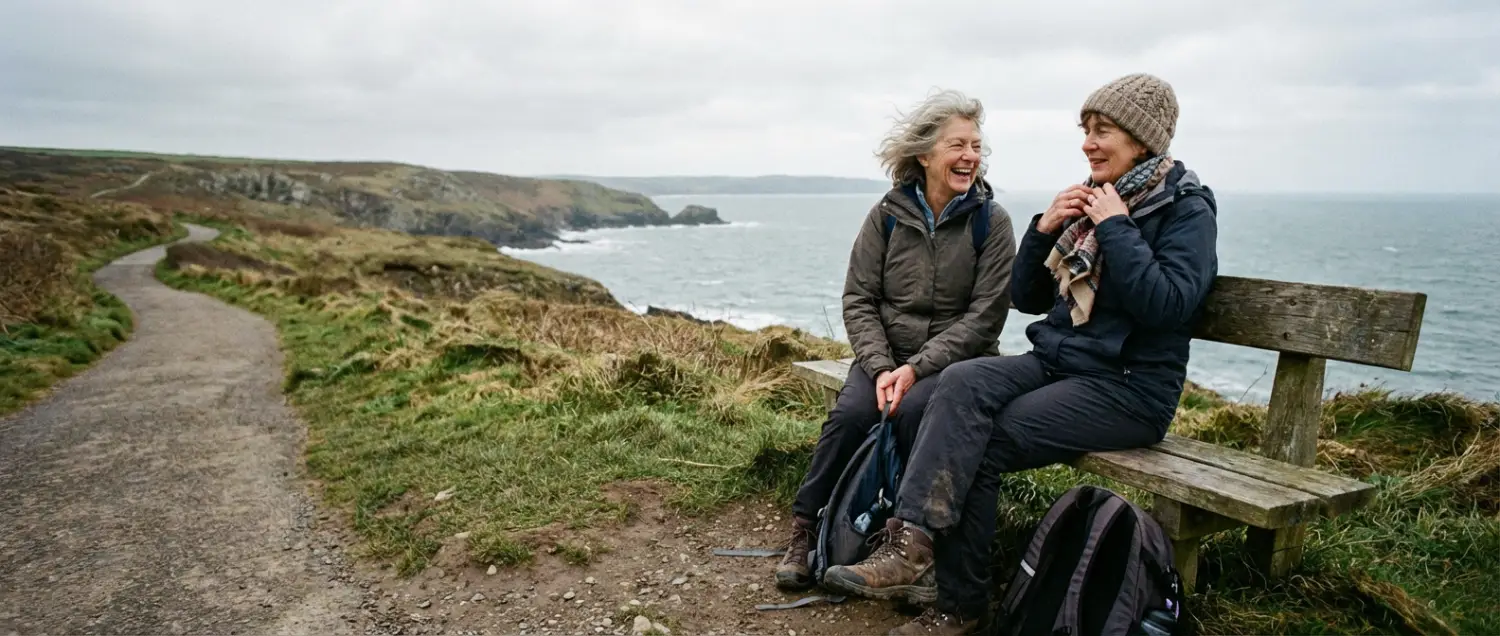
The evidence suggests that exercising in natural environments may confer additional benefits beyond those of indoor exercise alone. When compared with exercising indoors, exercising in natural environments has been shown to reduce cortisol levels, improve heart rate variability, and improve relaxation and mood.
The psychological benefits of being outside appear particularly robust. A recent meta-analysis found that nature-based interventions, including nature walks, demonstrated moderate-quality evidence for improving mood, and decreasing tension, confusion, and fatigue when compared to urban exercise, with older adults being associated with greater benefits.
However, although being in nature itself is associated with improved outcomes, exercising in nature optimises this. A small randomized controlled trial comparing mountain hiking to forest therapy found both interventions improved quality of life, life satisfaction and mood, but only mountain hiking showed improved physical benefits (such as aerobic capacity)- an effect that was more pronounced in women.
There is also a cognitive dimension. Navigating terrain, adjusting to changes in surface and gradient, and remaining aware of surroundings all place subtle demands on the brain. These are not present in the same way on a treadmill or a flat urban pavement. The implication is that hiking may engage both body and mind in ways that simpler forms of exercise do not.
Social connection: an underestimated health benefit
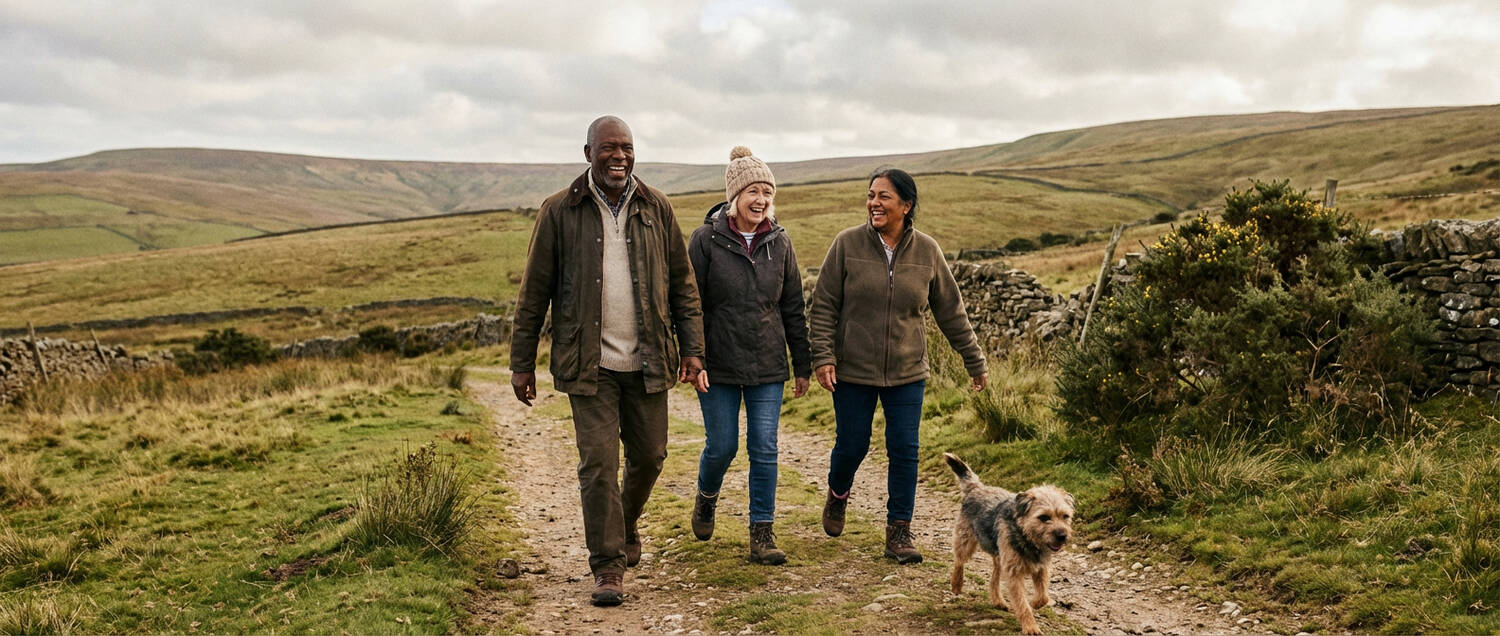
Social connection has emerged as one of the most important and under-recognised determinants of health in older age. Hiking is something that can help address social isolation as it can be done in a group. In fact, group-based walking interventions have been shown to improve not only physical health markers such as blood pressure and fitness but also reduce depression and improve wellbeing.
What if I am less fit than I used to be?
Feeling unfit is not a reason to avoid hiking. In fact, a study looking at an 8 week hiking intervention in older people aged 55-75 found that previously inactive participants showed the most dramatic improvements in quality of life and cardiovascular fitness.
The American Heart Association recommends using the talk-test to gauge appropriate intensity in older adults- moderate physical activity intensity level has been achieved when carrying on a conversation (but not singing) is possible.
Key strategies for those starting out or rebuilding fitness include starting with low-intensity hikes that don’t involve significant uphill portions, including well-marked paths and easy terrain. Remember, even downhill hiking demonstrates benefits,so if you are worried about fitness you can try and find hikes that start with a cable car. You can prepare for hiking by strengthening muscles around weight-bearing joints (particularly the knee) and making gradual rather than rapid changes in activity levels.
Conclusion
Hiking challenges the cardiovascular system, strengthens muscles in functionally relevant ways, engages the brain, provides exposure to natural environments, and can also help with social connection. Few activities bring these elements together so effectively.
The evidence base in general has a few limitations- most studies are small, and long-term data specific to hiking in older populations remain limited. Hiking also can’t replace strength training that is essential for preventing age-related muscle loss.
But, hiking delivers the kinds of physiological stimuli that are consistently associated with better health and independence in later life. And most importantly, it’s a fun and accessible type of exercise that can be enjoyed by many well into older age.